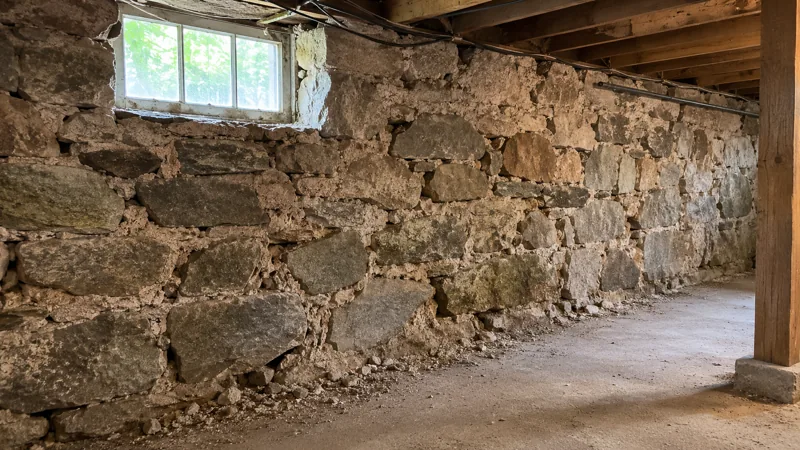
Stone Foundation Repair & Repointing
Stone foundation repair in Central Massachusetts almost always comes down to one thing: the mortar between the stones has failed, and it needs to be renewed with the right material. Antique fieldstone and rubble foundations are not simply older versions of modern concrete foundations. They were built as traditional masonry systems using fieldstone, rubble stone and comparatively soft lime mortar — and repairing them correctly means working the way they were built.
These walls manage moisture differently. They tolerate small amounts of seasonal movement differently. They also require a different repair approach.
At JB Mohler Masonry, we repoint antique stone foundations using materials and methods that respect how the original wall was built. The goal isn't to make an old foundation behave like poured concrete — it's to restore the system so it can keep doing its job.
Schedule an antique foundation evaluation →
Old does not mean poorly built. It means built by different rules.
Many antique homes throughout Central Massachusetts rest on thick stone foundation walls constructed long before reinforced concrete footings became standard.
Rather than sitting on a separate poured-concrete footing, these foundations were often built with broad walls, large base stones and carefully fitted masonry that distributed the weight of the house into the supporting soil.
The stones were commonly bedded and joined with lime-based mortar. Unlike modern cement-rich mortar, traditional lime mortar is relatively soft, breathable and able to accommodate slight movement.
That difference matters. Installing a mortar that is too hard or too dense can interfere with the way the wall manages moisture and movement. A repair may look strong on the surface while slowly causing damage around it.
Why lime mortar matters in an antique foundation
Lime mortar was not simply the glue holding the stones together. It was an active part of the foundation system.
It allows moisture to escape. Stone foundations are not typically waterproof walls — moisture can move through the soil, stone and mortar as conditions change. Traditional lime mortar is vapor-permeable, allowing moisture within the wall to migrate toward the joints and evaporate. The mortar provides a controlled path for the wall to dry. This doesn't mean lime mortar eliminates the source of basement water — gutters, grading, drainage and groundwater conditions still matter. But a compatible mortar helps prevent moisture from becoming trapped inside the masonry.
It accommodates slight movement. Antique foundations often experience small amounts of seasonal movement as soil moisture, temperature and building loads change. Lime mortar is more forgiving than hard cement mortar — its relative softness allows the joints to absorb modest movement without transferring all of the stress into the surrounding stone. Visible displacement, significant bulging and continuing settlement are not conditions to ignore. However, minor movement doesn't automatically mean an antique foundation has failed.
It protects the stone. In traditional masonry, the mortar joint is intended to be the maintainable part of the wall. Over many decades, the mortar gradually weathers and is eventually renewed — ideally, the joint deteriorates before the stone does. This sacrificial relationship is one of the reasons the replacement mortar should generally remain softer and more permeable than the surrounding masonry.
Is lime mortar really self-healing?
Lime mortar has a limited ability to heal very small cracks naturally. When moisture passes through a fine crack, it can carry available lime into the opening. As that lime reacts with carbon dioxide, it may form new calcium carbonate and partially seal the crack — a process sometimes called autogenous healing.
It's useful, but shouldn't be overstated. Lime mortar cannot reset a loose stone, repair a wide open joint or correct continuing structural movement. A foundation with substantial mortar loss still needs to be properly cleaned, packed and repointed.
Why hard cement repairs can create problems
One of the most common issues we encounter is an antique foundation that has been patched with hard Portland-cement mortar, hydraulic cement or an impermeable coating.
These materials may create a hard surface, but harder doesn't always mean better. Dense cement repairs can restrict the wall's ability to dry — moisture that once escaped through the mortar joint may instead remain trapped within the stonework or move around the patch. As moisture freezes, evaporates or carries salts through the wall, the surrounding stone and original mortar can deteriorate.
Hard repairs can also concentrate movement at the edges of the patch. Instead of the joint absorbing stress, the stone may crack, flake or loosen.
Not every mortar containing cement is automatically inappropriate — the correct repair material depends on the existing mortar, the type of stone, exposure conditions and the overall condition of the wall. The important principle is compatibility: the new mortar should work with the historic masonry rather than overpower it.
Signs your stone foundation may need repointing
A stone foundation doesn't have to look new to remain serviceable. Irregular stones, uneven joints and signs of age are normal. Repointing may be appropriate when you begin to see:
- Loose, sandy or crumbling mortar
- Deep open joints between stones
- Small piles of sand or mortar on the basement floor
- Stones that move when touched
- Visible voids inside the wall
- Cracked or separating cement patches
- Daylight passing through sections of the foundation
- Repeated damp areas that dry very slowly
- Localized bulging or displacement
- Water entering through open joints
- Mice, drafts, or drips coming through failed joints
Failed mortar joints are how mice get into the basement — they aren't paying rent — and how the wall gets drafty and drippy. Compatible lime repointing is what closes those gaps.
Crumbling mortar doesn't necessarily mean the entire foundation is failing — often, the mortar has simply reached the end of its service life and needs to be renewed. However, significant movement, widespread bulging or rapidly changing cracks may indicate a condition that requires further structural evaluation.
How we evaluate your foundation
A stone foundation's condition isn't something that can be judged from a photo the way a cracked chimney crown can — this is a job that starts with Jeff coming out and looking at the wall in person.
On-site, we check the walls for bowing, drafts, large cracks and movement. Because older homes typically have floor beams resting directly on the foundation wall with no pressure-treated lumber underneath, we also give those beams a look-over for rot — even though beam repair itself is outside the scope of a foundation repointing job. We check for anything unusual standing in for proper support where a lally column should be, too.
From there, you get a straight assessment: what needs to be repaired, what it will cost, how long it will take, and when we're available to start.
Schedule an antique foundation evaluation →
Our antique foundation repointing process
Proper repointing involves more than covering the face of the wall with fresh mortar. A thin surface coating may improve the appearance temporarily, but it does little to stabilize deep joints or fill internal voids. Our process is based on the actual condition of the foundation.
1. Evaluate the wall. We inspect the stone, existing mortar, previous repairs and visible moisture conditions — looking for loose stones, open joints, displacement, hard cement patches and areas where water may be entering.
2. Remove failed material. Loose and deteriorated mortar is carefully removed from the joints without unnecessarily damaging sound historic mortar or disturbing stable stonework. Incompatible repairs may also need to be removed when they're trapping moisture or separating from the wall.
3. Address loose stone and deep voids. Loose stones are reset where necessary. Deep joints and internal voids are properly packed rather than concealed behind a shallow layer of mortar — this restores contact within the wall and provides a solid base for the finished joint.
4. Install a compatible lime-based mortar. A suitable lime mortar is installed in lifts where required so that deep joints are filled properly. The mortar is selected to remain compatible with the surrounding stone and historic masonry.
5. Tool and cure the joints. The finished joints are tooled to shed excess water while maintaining the traditional appearance of the wall. Lime mortar also requires proper curing — temperature, humidity, sun and airflow must be considered so the mortar can develop strength gradually without drying too quickly.
Repointing is not the same as waterproofing
Repointing can close open joints, stabilize loose masonry and restore the foundation's ability to manage moisture. It cannot solve every basement water problem. Water may also be entering because of:
- Missing or overflowing gutters
- Downspouts discharging near the foundation
- Improper exterior grading
- Failed window wells
- Plumbing leaks
- High groundwater
- Poor perimeter drainage
- Exterior cracks or openings above the foundation
A responsible foundation repair should consider both the masonry and the source of the moisture. Covering the interior wall with a waterproof coating may hide the symptoms temporarily while forcing moisture to remain inside the masonry. The better approach is to understand why the wall is wet, correct exterior water problems where possible, and repair the foundation with compatible materials.
Interior and exterior repointing
Many antique foundations can be accessed from the basement interior, but repointing only the inside doesn't always address the entire wall. Exterior deterioration may continue to admit moisture even after the interior joints are repaired.
The appropriate scope depends on the condition of the foundation, access around the home and the location of the damage. In some cases, targeted interior repointing is sufficient. In others, exterior work or repairs on both sides of the wall may be recommended.
The goal isn't to sell the largest possible repair — it's to identify what the foundation actually needs.
Antique foundation repair requires judgment
Historic masonry rarely follows a perfect pattern. Stone size, wall thickness, mortar composition and previous repairs can vary considerably — even within the same foundation. That's why antique foundation work can't be reduced to using a particular bag of mortar. Successful repointing requires judgment:
- Which mortar should be removed?
- Which original material should remain?
- Are the stones stable?
- Are the joints shallow or deeply deteriorated?
- Is the wall experiencing ordinary aging or active movement?
- Is the moisture coming through the masonry or from somewhere else?
- Will a previous cement repair cause more damage if left in place?
With more than 20 years of hands-on masonry experience, JB Mohler Masonry approaches each antique foundation as an existing system that must first be understood. The work is performed by an experienced mason — not handed off after the estimate.
Antique stone foundation repointing in Central Massachusetts
We provide antique and fieldstone foundation repointing for historic homes throughout Central Massachusetts. Our work is well suited for homeowners who want to:
- Preserve an original stone foundation
- Replace deteriorated lime mortar
- Correct failed cement patches
- Stabilize loose stones
- Close deep open joints
- Improve the wall's ability to dry
- Maintain the historic character of the home
- Avoid inappropriate one-size-fits-all repairs
If your home has a block or poured foundation rather than antique stone, see our block foundation page instead — different construction, different repair approach.
Request a foundation evaluation →
Frequently Asked Questions
What makes an antique stone foundation different from a modern foundation?
Antique stone foundations were commonly built using thick walls of fieldstone or rubble stone joined with lime-based mortar. Many do not have a separate reinforced concrete footing like a modern poured foundation. The wall, mortar, stone and supporting soil function together as a traditional mass-masonry system.
Why should lime mortar be used in an old stone foundation?
Lime mortar is generally softer and more vapor-permeable than modern cement-rich mortar. This allows the foundation to release moisture through the joints and accommodate slight movement without placing excessive stress on the surrounding stone. The exact mortar should still be selected according to the original materials and wall conditions.
Will repointing stop water from entering my basement?
It can stop water that is entering through open or missing mortar joints, but it may not eliminate water caused by grading, gutters, groundwater, drainage problems or other exterior conditions. Repointing should be viewed as one part of the foundation's moisture-management system, not as a universal waterproofing treatment.
Does crumbling mortar mean my foundation is failing?
Not necessarily. Mortar is intended to weather gradually and be renewed. Loose or sandy joints may indicate that the mortar has reached the end of its service life while the stones and overall wall remain stable. Bulging, major displacement or rapidly changing cracks should be evaluated more carefully.
Should old cement patches be removed?
That depends on their condition and compatibility. A hard cement patch that is separating, trapping moisture or damaging the adjacent stone may need to be removed. A stable repair that isn't creating a problem may not always require immediate removal. Each area should be assessed individually.
Can lime mortar heal cracks by itself?
Lime mortar may partially close very fine cracks through a natural process in which available lime is carried into the crack and carbonates. This limited self-healing ability does not repair wide cracks, loose stones, deep voids or active structural movement.
Can you repoint only the inside of the foundation?
Sometimes. Interior repointing can restore deteriorated joints that are accessible from the basement. However, exterior deterioration may still allow water into the wall. The best approach depends on where the mortar has failed and how moisture is entering.
Is lime mortar weaker than cement mortar?
Lime mortar is typically softer, but that's often an advantage in historic masonry. The mortar joint is intended to accommodate movement and weather sacrificially before the stone is damaged. The objective isn't to install the strongest possible mortar — it's to install the most compatible mortar for the wall.
How long does lime mortar take to cure?
Lime mortar develops strength gradually through carbonation and requires controlled curing conditions. The surface may become firm relatively quickly, but the mortar continues to harden over time. It must be protected from rapid drying, freezing temperatures, heavy rain and excessive heat during the early curing period.
What time of year is best for foundation repointing?
Lime mortar performs best when temperatures and moisture conditions can be controlled. Work is generally scheduled during suitable weather, avoiding freezing conditions and periods of extreme heat or rapid drying. Interior basement conditions may allow a somewhat broader working season, depending on temperature and humidity.
Preserve the foundation instead of covering it up
An antique stone foundation has already supported the home for generations. When the mortar begins to fail, the answer isn't always a harder patch, a waterproof coating or a modern material forced into an old wall.
The right repair starts with understanding how the foundation was built, how it manages moisture, and which materials will let it keep functioning.
Contact JB Mohler Masonry to schedule an antique stone foundation evaluation — call (978) 365-6800 or request an evaluation online.
How it works
Related work and guidance
When the problem includes movement or damaged stone, see how masonry repair starts with identifying the source of movement, moisture, or mortar failure.
For a modern foundation system with different repair needs, review how concrete block foundations are built and repaired differently from antique stone foundations.
Send a photo.
Get a straight answer.