Tuck Pointing

Re-Pointing or “Tuck-Pointing” Service in Massachusetts
In Massachusetts, masonry is found on nearly all homes and buildings to some extent. Masonry is often thought of as permanent and ever lasting, but over time will be subject to deterioration especially at the mortar joints. The method of repairing worn or damaged mortar joints is called repointing, and often referred to as tuck pointing.
This is done by grinding out the mortar joints with a grinder or chiseling them out with a hammer and chisel. The mortar joints are then filled with the appropriate mortar. Repointing brickwork is a job that needs skill in order to be performed correctly or it will not look very appealing.
If you're weighing repointing against replacing the wall, review when deteriorated mortar joints call for professional tuck pointing instead of another surface patch.
One of the main things about brickwork repairs is being able to properly perform the task without causing more damage than what has already occurred to the structure. A lot of the time repointing is all that is needed on your chimney or masonry structure to restore its appearance and maintain its structural integrity.
JB Mohler Masonry takes all necessary precautions when performing repointing services on your property. It is irresponsible to grind out mortar joints without controlling the dust. In populated areas we never use a grinder without dust extraction, letting the dust fly wherever it may. At JB Mohler Masonry we use specialty grinders that maintain a 95% dust free cutting of the mortar joints.
Our Massachusetts Re-Pointing Services
- Re-Pointing
- Tuck Pointing
- Repointing Masonry
- Lime Mortar
- Brick Repair
- Brickwork Pointing
- Mortar Repair
- Repointing Brickwork
- Brick Pointing
- Masonry Restoration
- Repointing Bricks
- Chimney Repointing
Where we repoint
- Chimneys. The most exposed masonry on the house. Our chimney repointing page explains how we decide between repointing and rebuilding.
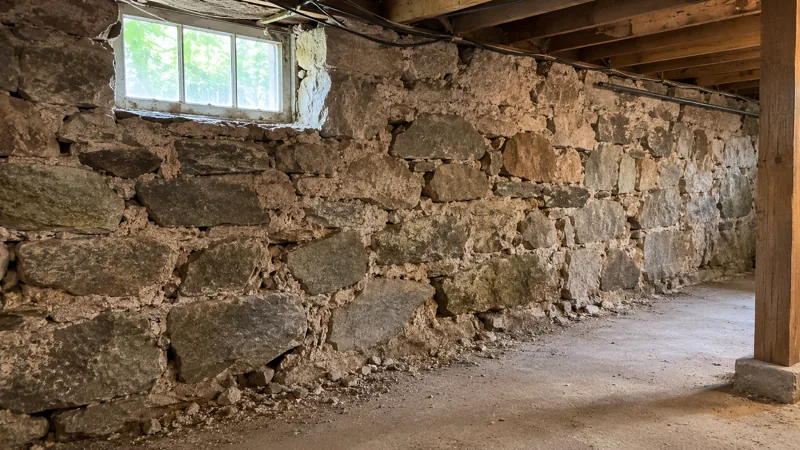
- Antique stone foundations, with lime mortar. See antique stone foundation repointing.
- Brick and stone walls, steps, and retaining walls.
- Fireplaces, where open joints in the firebox or surround need to be closed up.
Matching the mortar
New mortar has to match the old in more than color. It has to match in hardness. Older brick and stone were laid in soft lime mortar, and a modern high-cement mortar is harder than the brick around it. Point an old wall with it and the joint outlasts the brick: moisture can't move out through the mortar anymore, so it moves through the brick and breaks the faces off. We match the original mix, lime where the wall was built with lime.
Depth matters too. We take the old mortar out to sound material, usually about twice as deep as the joint is tall, so the new mortar has something to hold onto.
Questions about repointing
What's the difference between repointing and tuck pointing?
Most people use the two words to mean the same job, and so do we. Strictly speaking, repointing is replacing failed mortar, and traditional tuck pointing is a decorative finish that uses a fine line of contrasting mortar to make the joints look crisp. If you're searching for tuck pointing, you almost certainly want repointing.
How do I know if my masonry needs repointing?
Mortar that's recessed back from the face of the brick or stone, sandy or crumbling to the touch, or missing altogether. If you can dig it out with a key or a finger, it's time.
How long does repointing last?
Done right, with the right mortar packed to the right depth, decades. Shallow patching smeared over old mortar might make it through a couple of winters.
Can repointing be done year-round?
Fresh mortar can't freeze before it cures, so cold-weather repointing takes protection, and some jobs wait for spring. Spring through fall is the easy window.
We offer our repointing services throughout Worcester County, Middlesex County, and Norfolk County. If you'd like to schedule an estimate for your tuck pointing project, give us a call at (978) 365-6800 or fill out our online contact form and we'll get right back to you.
How it works
Related work and guidance
When cracked units or movement go beyond the joints, see how masonry repair starts with identifying the source of movement, moisture, or mortar failure.
For lime-mortar walls below an antique home, review how antique stone foundations are repointed with compatible mortar while checking for movement and rot.
Send a photo.
Get a straight answer.