Behind an Old Chimney in Lancaster
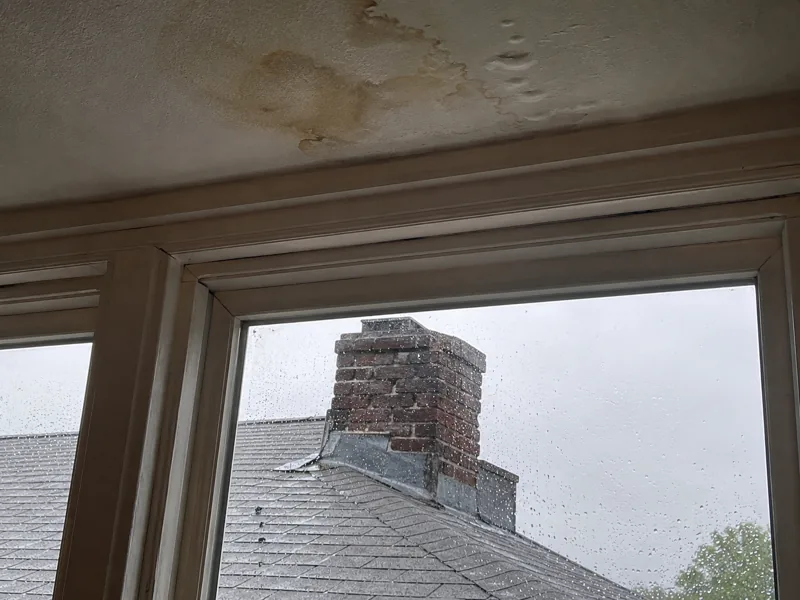
Most homeowners never think about their chimney until something goes wrong. A smell. A stain on the ceiling. A draft that wasn’t there last winter. By the time those signs appear, the damage behind the brick has usually been building for years — quietly, invisibly, one freeze-thaw cycle at a time.
That’s the thing about old chimneys in central Massachusetts. They look solid from the outside. The brick is still there. The mortar hasn’t crumbled into a pile on your patio. Everything seems fine, until you take a look behind an old chimney and realize the exterior was just a mask.
This is the story we see play out over and over again across Lancaster, Leominster, Harvard, and the surrounding towns. Old colonial homes. Fieldstone foundations. Chimneys that have been standing since before anyone alive today was born. They’re built to last, but they’re not built to last forever without attention.
The Outside Doesn’t Tell You Much
Here’s the frustrating part for most homeowners: you can walk around your house, look up at the chimney from every angle, and still have no idea what’s happening inside it. The brick face can look perfectly intact while the liner is cracked, the flashing is leaking, and the mortar joints behind the brick veneer have turned to powder.
Think of it like a loaf of bread that’s been left out too long. The crust holds its shape. You pick it up, it feels solid. Then you squeeze it and the whole inside collapses. Old chimney systems work the same way. The outer wythe of brick is the crust. What’s behind it — the liner, the fill, the flashing, the smoke chamber — that’s where the real story lives.
90% of chimney failures originate from water intrusion — not fire damage or structural collapse. (Chimney Safety Institute of America)
Water is the enemy. It always has been. And in New England, where we get hard freezes from November through March and then a wet spring on top of that, water finds every opportunity to work its way in. A hairline crack in a mortar joint is all it needs. Once it’s inside, the freeze-thaw cycle does the rest, expanding that crack a little wider each winter until what was a hairline becomes a gap you could fit a pencil in.
What “Looked Fine” Actually Meant
We’ve been called to jobs where a previous contractor (sometimes more than one) told the homeowner the chimney was in good shape. Pointed a few joints. Slapped some sealant on the flashing. Collected a check and moved on.
Then the homeowner calls us because the smell is back. Or the water stain reappeared. Or the damper is rusting shut.
When we get up there and actually open things up, what we find is almost always the same: the surface work was done, but nobody looked behind the chimney. Nobody pulled the flashing to see what was underneath. Nobody ran a camera down the liner. Nobody checked the smoke chamber for cracks or the firebox for spalled brick that’s been patched with the wrong mortar.
| The Myth | The Reality | | --- | --- | | If the brick looks good, the chimney is fine. | The exterior wythe is the last thing to show damage. Interior deterioration is almost always worse than what’s visible from outside. | | Sealing the outside stops water problems. | Surface sealants can trap moisture inside the masonry, accelerating freeze-thaw damage from within. | | A chimney that draws well is a safe chimney. | Draft performance and structural integrity are separate issues. A cracked liner can vent carbon monoxide into living spaces even when the fireplace appears to draw normally. | | Repointing fixes the problem. | Repointing addresses mortar joints. It doesn’t touch the liner, flashing, smoke chamber, or any interior components where most damage occurs. | | Old chimneys are built better than new ones. | Older construction used lime mortar and hand-laid brick, which has advantages, but also means decades of accumulated wear with no modern waterproofing or liner protection. |
What’s Actually Back There
So what do you find when you genuinely look behind an old chimney? It depends on the age of the home, the chimney’s construction type, and how it’s been maintained. But here are the things that show up most often in the older housing stock across this part of Massachusetts.
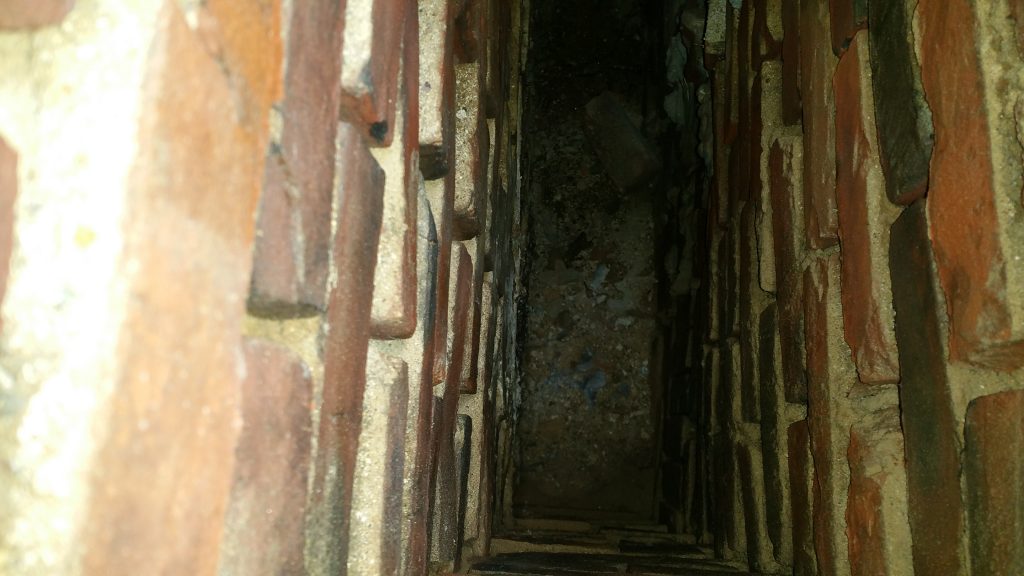
The liner. Most chimneys built before the 1980s either have no liner, a clay tile liner that’s cracked, or a liner that was retrofitted at some point and may not be the right size for the appliance it’s serving.
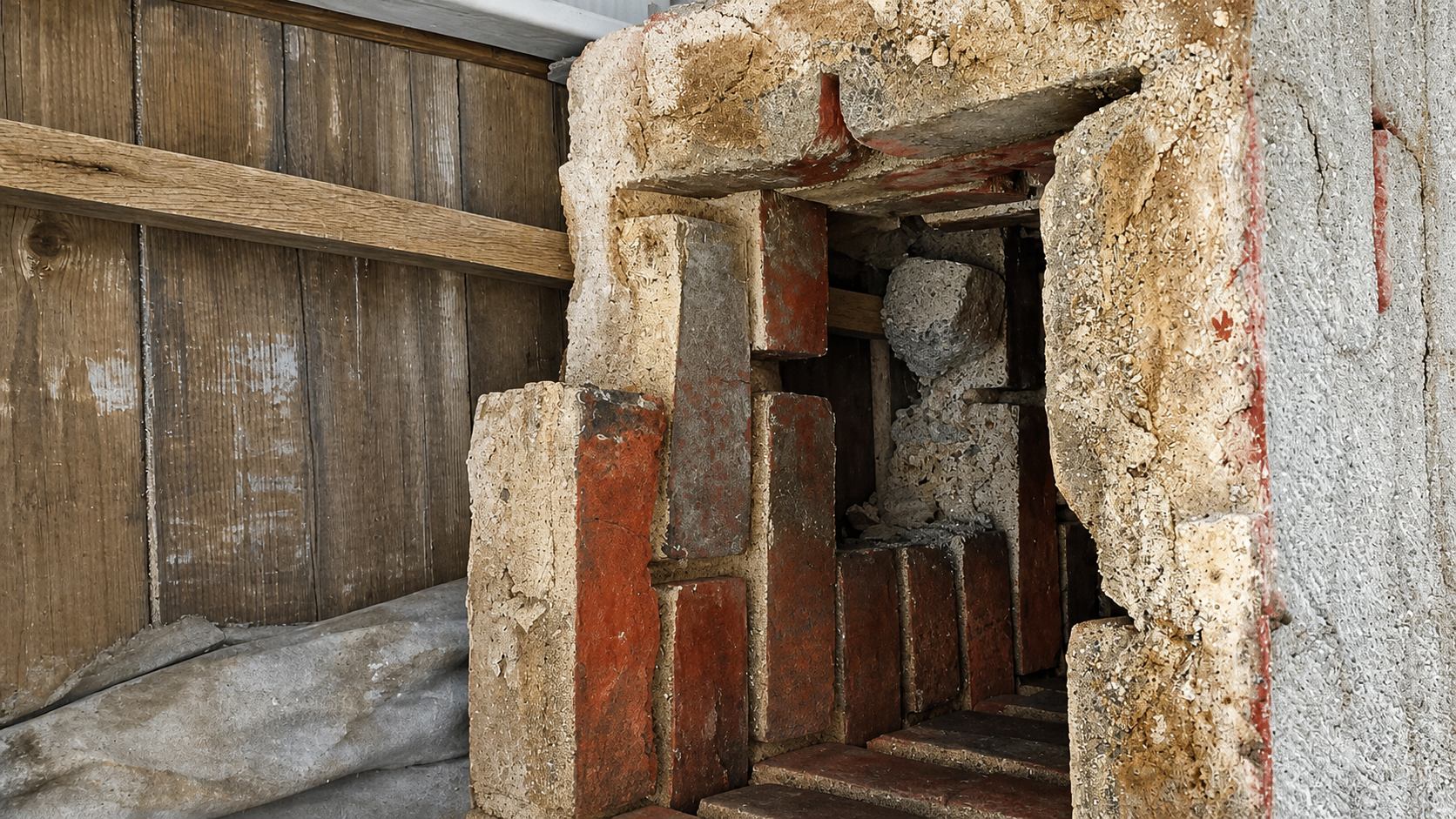
This was alarming to find: the only thing separating combustion gases from the interior of the home was standard sheetrock. This is not just a repair issue, it’s a fundamental failure of the chimney system.
The flashing. Step flashing and counter flashing where the chimney meets the roof is one of the most common failure points we see. It corrodes, it separates, it gets repaired with roofing tar that holds for one season and then cracks. When the flashing fails, water runs straight down the inside of the chimney chase and into the wall cavity below.
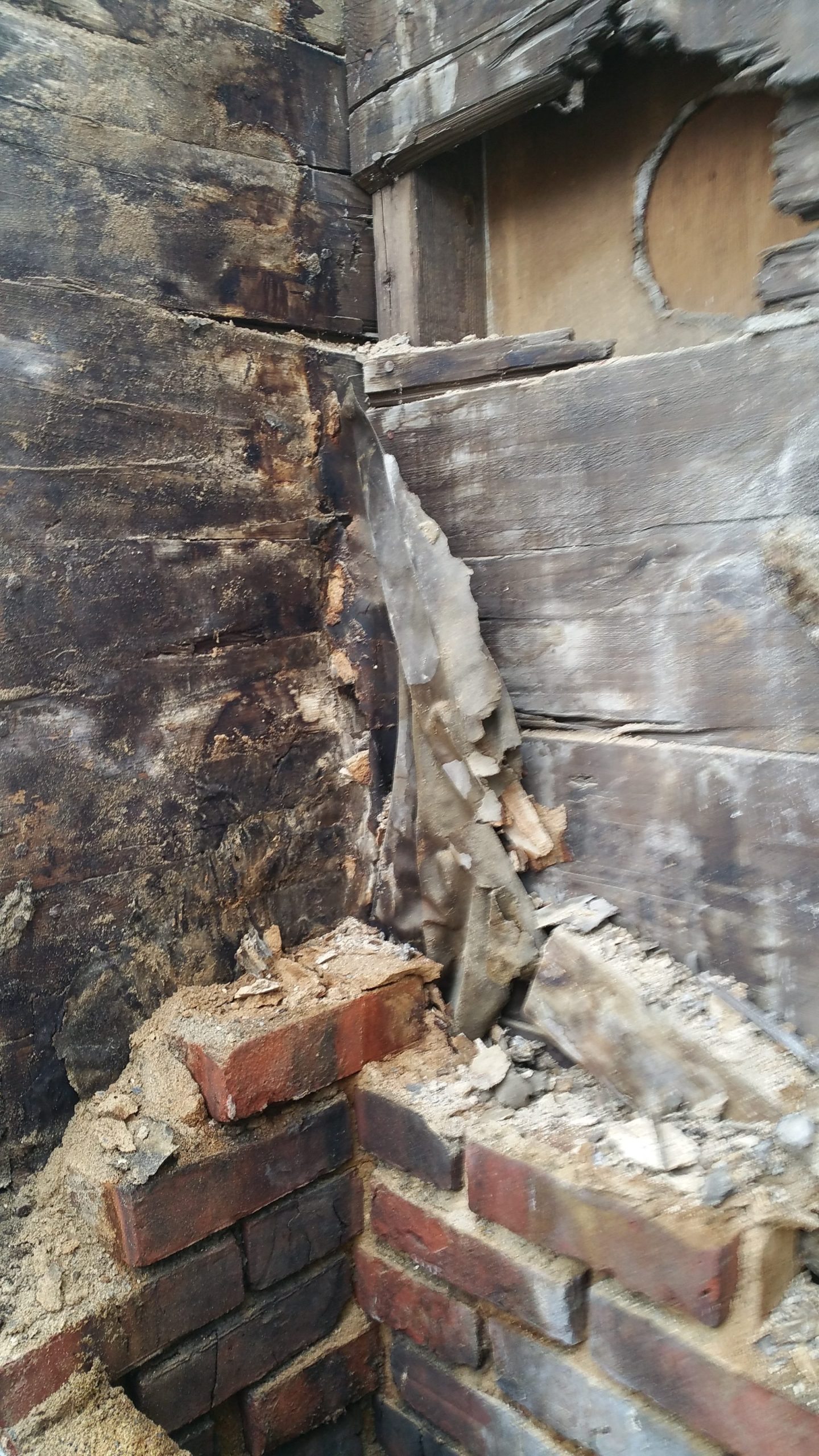
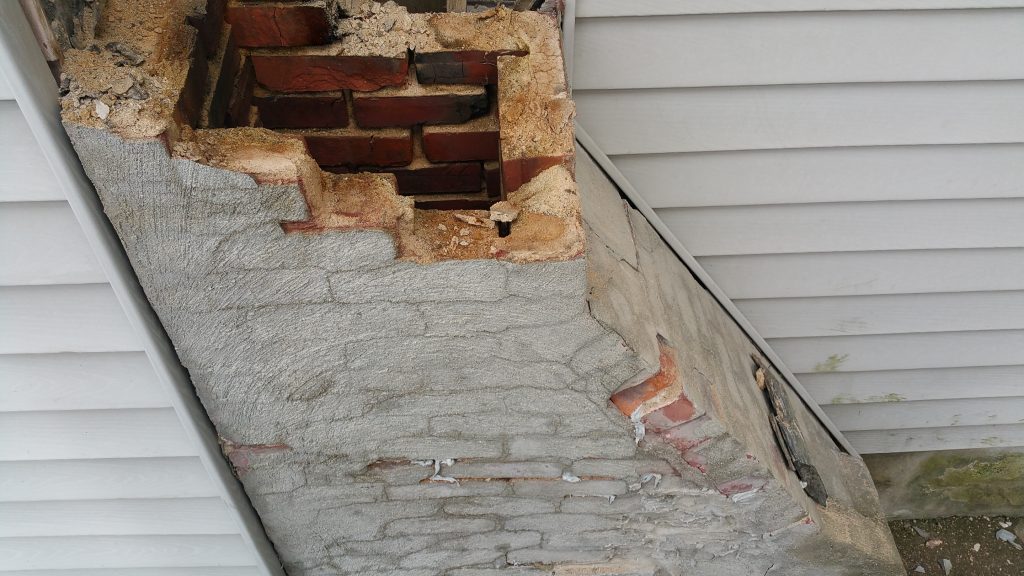
This is an extreme example of chimney failure, but the underlying issue is common: poor moisture management. A single layer of tar paper is not adequate protection, and over time it allows water intrusion that leads to rot and structural breakdown. In this case, significant sections of the sheathing had to be replaced due to prolonged exposure.
The smoke chamber. This is the corbeled section just above the firebox, below the flue. In older chimneys it’s often rough-cut brick with open joints, exactly the kind of surface that absorbs creosote and allows gases to seep through. A parged smoke chamber is the standard now, but most old chimneys never had it.
The firebox itself. Spalled brick, cracked refractory panels, joints filled with the wrong mortar (standard portland cement instead of refractory mortar) — all of it adds up. Portland cement is harder than the brick around it, so when it expands and contracts with heat, it damages the brick rather than flexing with it.
1 in 3 older New England chimneys inspected annually show liner damage significant enough to require repair before safe use. (Industry inspection data, CSIA-certified inspectors)
Why Old Doesn’t Mean Bad — But It Does Mean Different
None of this is meant to scare you away from an old chimney. The fieldstone and brick chimneys you find on 18th and 19th century homes in towns like Concord, Harvard, and Bolton were built by craftsmen who knew what they were doing. Lime mortar, hand-laid brick, thick walls: there’s a reason those structures are still standing.
But old construction requires old-construction thinking when it comes to repair. You can’t patch a lime mortar joint with a modern portland-based mortar and expect it to hold. The hardness mismatch will cause the surrounding brick to crack before the mortar does. You have to match the original material — softer mortar, similar aggregate, similar color — or you’re creating a new problem while you’re trying to fix the old one.
| What Often Gets Done | What Should Be Done | | --- | --- | | Portland cement mortar used for repointing | Lime-based mortar matched to original joint composition | | Surface sealant applied over cracked flashing | Flashing removed, reseated, and replaced with proper step and counter flashing | | Smoke smell addressed with a new damper | Smoke chamber inspected and parged / liner evaluated for cracks | | Exterior brick cleaned and sealed | Interior liner scoped with camera before any surface work begins | | Firebox cracks filled with standard mortar | Refractory mortar used / damaged firebrick replaced |
The Inspection That Changes Everything
The single most useful thing you can do with an old chimney — before you burn a fire in it, before you call anyone for a repair, before you do anything — is get a proper inspection. Not a visual check from the roofline. A Level 2 inspection: camera down the liner, flashing examined, smoke chamber checked, firebox evaluated.
It costs money. It takes time. And it will tell you more about the actual condition of your chimney than any amount of looking at the outside ever could.
Before any repair, before any fire — get a camera inside the liner. Everything visible from the outside is the last place damage shows up, not the first.
What you learn from that inspection shapes everything that comes after. Maybe the liner is intact and you just need some repointing and new flashing. Maybe the liner is cracked and needs a stainless steel insert before the fireplace is safe to use. Maybe the smoke chamber needs parging. Maybe the flashing has been leaking for so long that there’s rot in the framing behind the chimney that needs a carpenter before we can do anything.
You don’t know until you look. And looking properly — really looking, not just glancing at the brick from the driveway — is the whole job.
What We Do Before We Touch Anything
When we take on a chimney job, the inspection comes first. Always. We’re not going to quote you a repointing job without understanding what’s happening behind the brick, because repointing a chimney that has a failing liner is like painting a house that has a rotting frame. You’re spending money on the wrong thing.
We work across Lancaster, Leominster, Groton, Westford, Acton, Stow, Maynard, Sudbury, Wayland, and the surrounding towns, and the chimneys we see in this part of Massachusetts have their own character. Older housing stock, harder winters, a lot of deferred maintenance from previous owners who didn’t know what they didn’t know. We’ve seen the full range of what time and weather do to masonry, and we’ve learned to look for the things that aren’t obvious.
Frequently Asked Questions
How do I know if my old chimney is safe to use?
The only reliable way is a Level 2 inspection, which includes a camera scope of the liner, examination of the flashing, smoke chamber, and firebox. Visual inspection from outside the home cannot tell you whether the liner is cracked or the smoke chamber is compromised.
What’s the difference between repointing and a full chimney repair?
Repointing addresses the mortar joints between bricks on the exterior. A full chimney repair may include liner work, flashing replacement, smoke chamber parging, firebox rebuilding, or crown repair, all of which are separate from the mortar joints and require their own assessment.
Can I use my fireplace while I wait for repairs?
That depends entirely on what the inspection finds. A cracked liner is a serious safety issue: carbon monoxide can enter living spaces through liner cracks even when the fireplace appears to draw normally. Don’t assume a working fireplace is a safe one.
Why does the mortar type matter so much on old chimneys?
Older chimneys were built with lime mortar, which is softer and more flexible than modern portland cement. When you repoint with portland cement, the harder mortar transfers stress to the surrounding brick during expansion and contraction, causing the brick to crack rather than the mortar joint. Matching the original mortar composition is essential for old masonry.
How often should an old chimney be inspected?
The NFPA recommends annual inspections for chimneys in regular use. For an older chimney that hasn’t been inspected recently, start with a Level 2 inspection before the next heating season.
What causes the musty or smoky smell even when we’re not using the fireplace?
That smell usually means water is getting in somewhere (through cracked flashing, a deteriorated crown, or open mortar joints) and mixing with old creosote deposits in the liner or smoke chamber. It’s a reliable sign that something needs attention, even if the fireplace itself seems to be working.
Let’s Take a Real Look at Yours
If you’ve got an old chimney and you’re not sure what’s behind the brick, that uncertainty is worth resolving. Not because every old chimney is a disaster waiting to happen — most of them aren’t — but because knowing what you’re dealing with lets you make smart decisions about chimney repair, timing, and budget.
We serve homeowners across Lancaster, Leominster, Harvard, Hudson, Marlborough, Concord, Acton, Boxborough, Littleton, Groton, Ayer, Stow, Maynard, Sudbury, Wayland, Westford, Bolton, Berlin, Sterling, and Rutland.
Request a Masonry Estimate Today at jbmohlermasonry.com/contact-us or call us at (978) 365-6800, Monday through Friday, 8AM to 5PM.
Related masonry guides
For a closely related explanation, see why shortcuts in chimney construction lead to early cracking, leaking, and masonry failure.
For the next practical step, review how the parts of a masonry chimney and fireplace work together to draft safely.