The Ultimate Guide to Fresh Air Source for New Fireplaces
When the Fire Needs to Breathe: What We Learned Building a New Fireplace in Lancaster
Before the first shovelful of dirt is moved or any mortar gets mixed, this is the picture every homeowner has in their head: a freezing January night in Lancaster, a massive stack of wood roaring in a custom brick hearth, and a chimney that draws so perfectly you don’t smell a single whiff of smoke in the living room.
That’s the end goal, and it’s why people hire us.
But if you walked onto our job site today, you wouldn’t see any of that. Right now, we’re knee-deep in the loud, dusty, completely unglamorous rough-in stage: the exact phase where a single missed detail gets permanently buried in solid concrete, and where the actual success of that future fire is decided.
A fresh air source for new fireplaces isn’t glamorous. It won’t make the cover of an architecture magazine.
But skip it, or get it wrong, and you’ll spend years wondering why your fireplace smokes back into the room, why your HVAC system feels “off,” or why the house smells like a campfire every time someone lights a match.
We’re in the middle of a new construction chimney and fireplace build right now in Lancaster, MA, and this small detail is exactly what we want to walk you through.
The Problem Nobody Sees Coming
Here’s the thing about modern houses: they’re built tight. Intentionally, aggressively tight.
Spray foam insulation. Vapor barriers. Energy-efficient windows with compression seals. All of it is designed to keep conditioned air inside and outside air out. That’s good for your heating bill. It’s good for your comfort. But it creates a problem that older homes never had to solve.
Old houses leaked. Not in a bad way — or at least, not entirely. Those drafty gaps around window frames and under doors meant there was always a slow, passive supply of outside air trickling in. When a fireplace needed combustion air to keep a fire burning, it pulled from that ambient supply without anyone thinking twice about it.
A new house doesn’t have those leaks. When a fireplace starts drawing air up the flue, it has to get that air from somewhere. And if there’s no dedicated outside source, it will compete directly with your HVAC system, your exhaust fans, your dryer vent — anything that moves air in or out of the building envelope. The result is a house that’s fighting itself. Negative pressure builds up. Backdrafting happens. The fireplace pulls air down the chimney instead of up it, and suddenly your living room smells like smoke.
What Energy Codes Actually Say
This isn’t just a best-practice recommendation. Building codes have caught up to the physics.
The International Residential Code (IRC) Section R1006 addresses this directly. It requires that factory-built fireplaces and masonry fireplaces in tight construction be provided with a source of combustion air from the exterior of the building. The code specifies that the opening must be at least 6 square inches in area, and it must be located within 24 inches of the fireplace opening, either below the firebox or at floor level nearby.
Some local jurisdictions adopt amendments that are more specific still. In Massachusetts, the state building code (780 CMR) incorporates the IRC with amendments, and energy code compliance under the Massachusetts Stretch Energy Code (which many towns in our service area have adopted) makes tight construction the baseline assumption. That means the fresh air requirement isn’t optional. It’s baked into the permit.
Pro tip: Before your fireplace rough-in, confirm with your local building inspector whether your town has adopted the Stretch Energy Code. It affects how your fresh air intake gets sized and documented.
What a Fresh Air Source Actually Is
Let’s get concrete — literally.
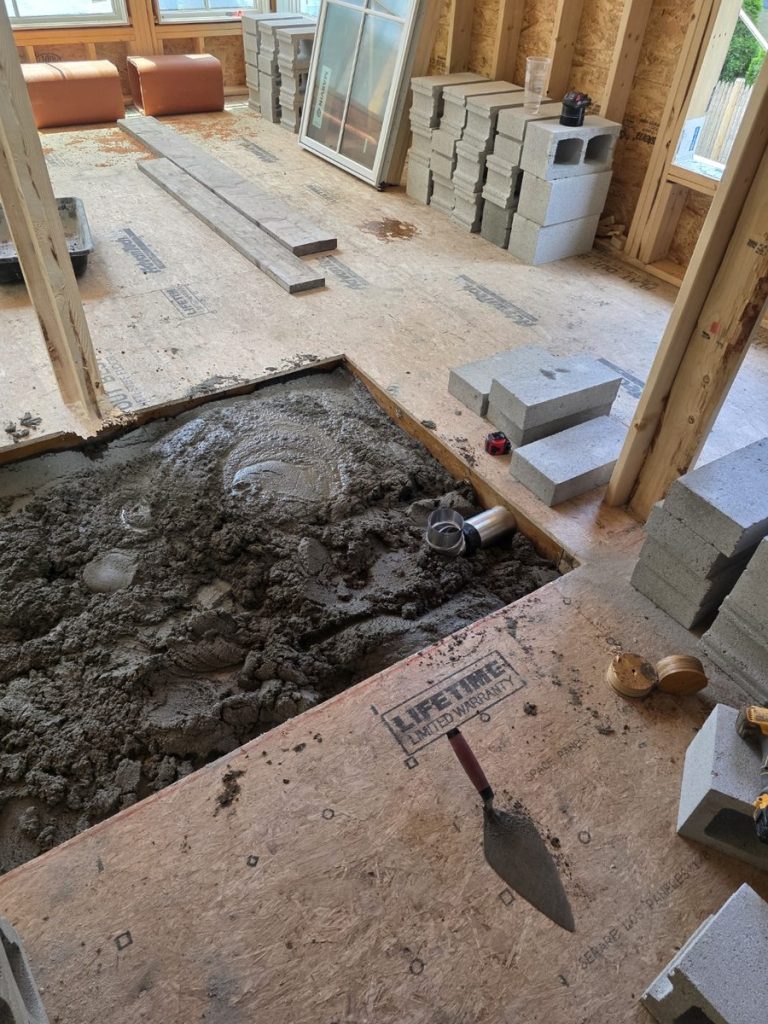
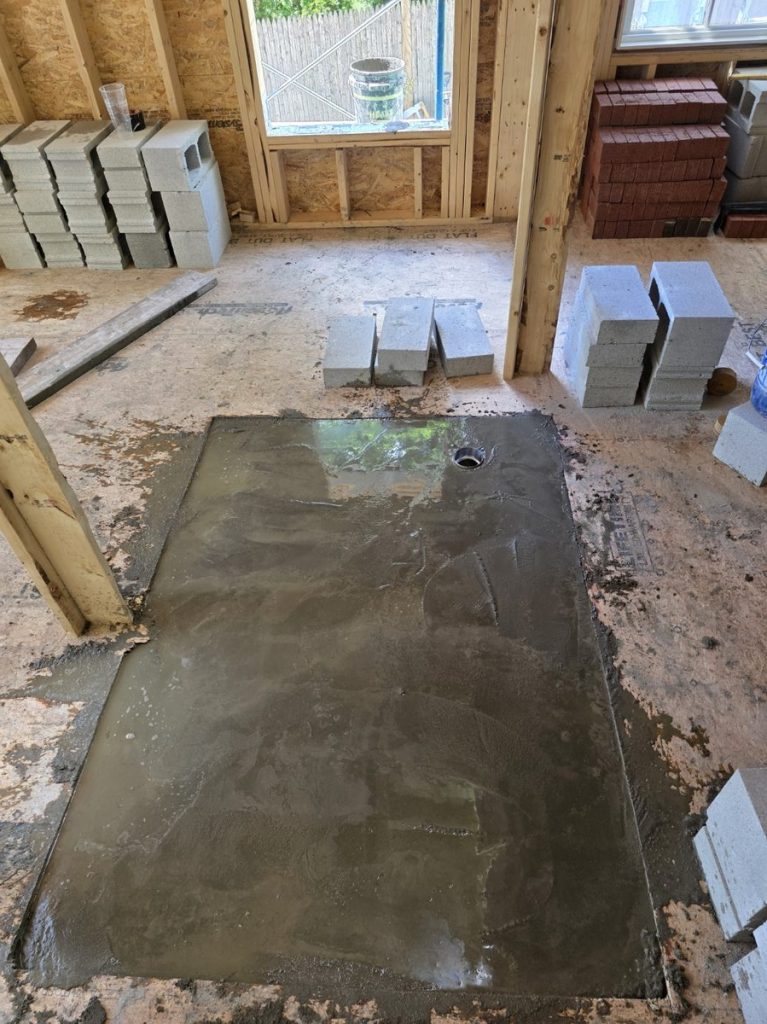
What you’re looking at in a new construction fireplace pour is the hearth being formed. The hearth serves two purposes: it’s the structural concrete pit the fireplace sits on, and it becomes the finished brick or stone surface in front of the opening that you see from the room. During that pour, before the concrete goes in, a pipe gets set into the form.
In our Lancaster build, that’s a 4-inch aluminum pipe running through the concrete. It doesn’t look like much. It looks exactly like what it is: a hole for airflow.
That pipe runs from the firebox area, through the poured concrete hearth, and then continues underneath, between the floor joists in the basement, until it exits through the rim joist or band joist to the outside of the house. Outside air enters the pipe, travels through the basement, through the hearth, and arrives at the firebox ready to feed the fire.
The aluminum pipe doesn’t need to be a structural or safety device on its own. It’s completely encased in solid concrete. The concrete does the structural work. The pipe just holds the channel open while the concrete cures, and then serves as the conduit for the rest of the fireplace’s life.
Why This Detail Gets Missed
If you’ve ever seen a fireplace rough-in, you know how much is happening at once. The foundation work, the hearth pour, the firebox construction, the flue liner, the chimney stack. It’s a sequence of trades and inspections that moves fast. The fresh air pipe has to go in before the concrete is poured. Once that hearth is set, you can’t go back.
That’s the window. Miss it, and you’re either cutting through finished concrete later (expensive, disruptive, and structurally questionable) or you’re building a fireplace that will never work the way it should in a tight house.
We’ve seen fireplaces installed without fresh air intakes in newer homes. The homeowners usually don’t find out until after move-in, when they light the first fire and the smoke rolls back into the room. By then, the fix is a retrofit, and retrofits are never as clean or as cheap as doing it right the first time.
How the Pipe Gets Routed
In a basement foundation build, the pipe typically runs horizontally between floor joists from the hearth area to an exterior wall. It terminates through the rim joist — the framing member that sits on top of the foundation wall — with a screened cap on the outside to keep pests and debris out.
The run should be as short and straight as possible. Every elbow adds resistance. Every foot of horizontal run adds a small amount of friction loss. For a 4-inch pipe serving a standard residential fireplace, you have some margin to work with, but the goal is always a clean, direct path to outside air.
The exterior termination needs to be positioned thoughtfully, too. It shouldn’t be directly below a window that gets opened in warm weather. It shouldn’t be in a location where snow drifts or landscaping could block it. And it should be accessible enough that a homeowner can inspect the screen cap periodically and clear any debris.
What This Looks Like in Practice
Here’s the sequence as it actually happens on a new construction job like our Lancaster project:
- Foundation and hearth forms are set. The concrete form for the hearth pit is built before any concrete is poured.
- The pipe is placed in the form. The 4-inch aluminum pipe is positioned so one end sits near the firebox and the other end exits the form toward the basement.
- Concrete is poured around the pipe. The pipe becomes permanently embedded in the hearth structure.
- Basement routing is completed. The pipe is extended through the floor joist bay to the exterior rim joist.
- Exterior termination is installed. A screened cap is fitted on the outside of the house.
- Inspection. The fresh air opening is verified by the building inspector as part of the fireplace rough-in inspection.
It’s not complicated. But it has to happen in the right order, at the right time, by someone who knows it needs to happen at all.
The Bigger Picture
A fireplace is a system. The fire, the firebox, the flue, the chimney, the house itself — they all interact. When one part of that system is starved for what it needs, the whole thing suffers.
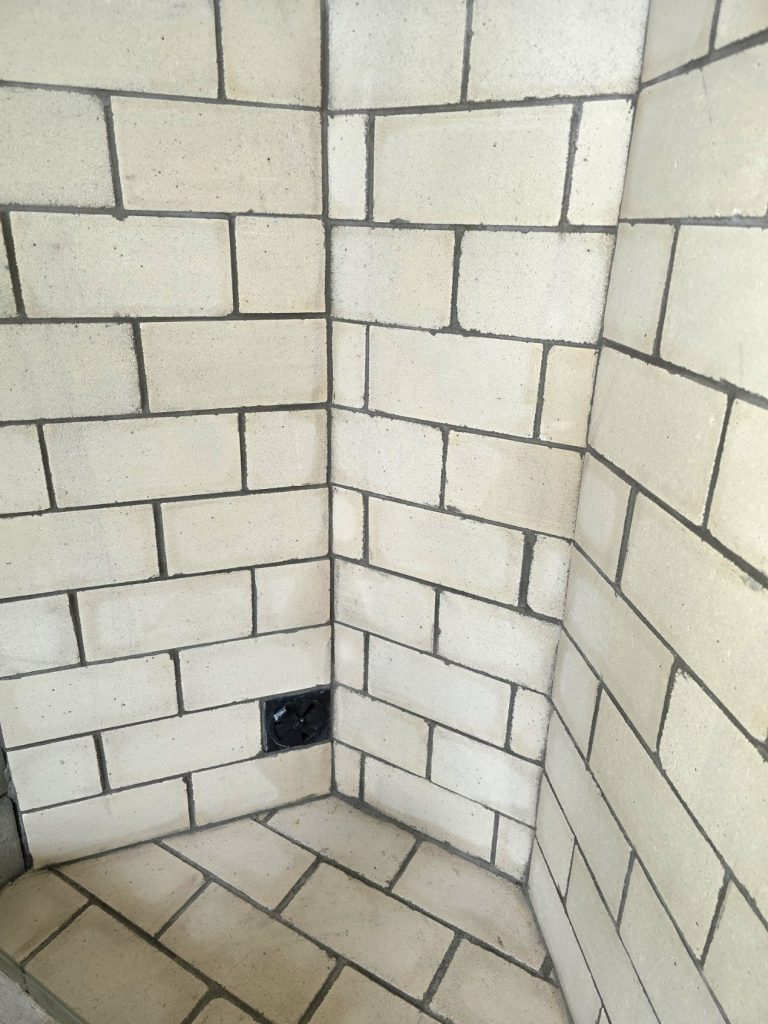
Fresh air supply is the part of that system that lives in the concrete, out of sight, doing its job quietly for the life of the fireplace. Nobody will ever see it. Nobody will ever think about it. But the homeowner in Lancaster will light a fire on a January night, and the smoke will go up the chimney the way it’s supposed to, and the house will stay in pressure balance, and the HVAC system won’t fight the fireplace for air.
That’s the whole point. Small details, done right, disappear into the background, which is exactly where they belong.
Key Takeaways
| Topic | What to Know | | --- | --- | | Why it matters | Modern tight construction eliminates the passive air leaks older fireplaces relied on | | Code requirement | IRC R1006 requires exterior combustion air; MA 780 CMR incorporates this standard | | Minimum opening size | 6 square inches per IRC; verify local amendments | | Typical installation | 4″ aluminum pipe embedded in hearth concrete, routed through basement to exterior | | Critical timing | Pipe must be set before the hearth concrete is poured — no retrofit shortcut | | Exterior termination | Screened cap on rim joist; keep clear of windows, snow accumulation, and debris |
FAQ
Does every new fireplace need a fresh air intake?
In most modern construction, yes. If your house is built to current energy codes (which includes most new construction in Massachusetts), the building envelope is tight enough that a dedicated combustion air source is required by code and essential for proper fireplace function.
Can I add a fresh air intake to an existing fireplace?
It’s possible, but it’s a retrofit, which means cutting through finished materials to run a duct to the exterior. It’s more expensive and more disruptive than doing it during construction. If you’re having an existing fireplace rebuilt or significantly modified, that’s the right time to add one.
What size pipe is typically used?
A 4-inch pipe is common for residential fireplaces. The IRC specifies a minimum of 6 square inches of net free area, which a 4-inch round pipe exceeds. Your mason or building inspector can confirm the right sizing for your specific firebox dimensions.
Where does the pipe exit the house?
Typically through the rim joist in the basement, terminating on the exterior wall with a screened cap. The exact location depends on the foundation layout and the routing path through the floor joist bay.
Will I see or notice the fresh air intake inside the house?
Usually not. The pipe is embedded in the concrete hearth. The only visible element might be a small grille or opening near the firebox, depending on the fireplace design. Most homeowners never think about it — which means it’s working.
Ready to Build Your Fireplace the Right Way?
If you’re planning a new construction fireplace or a full chimney rebuild, the details that matter most are the ones that get set in concrete. We build custom fireplaces and hearths across Lancaster, Leominster, Concord, Acton, Sudbury, and the surrounding towns in Central and MetroWest Massachusetts, and we’ve seen what happens when the small stuff gets skipped.
Planning a custom masonry build in Central MA or MetroWest?
The details that matter most are the ones that get set in concrete. Let’s make sure your project is built to last, fully compliant, and delivers your vision perfectly!
📞 Call (978) 365-6800 (Mon–Fri, 8AM–5PM) or our fireplace and chimney construction services.
Related masonry guides
For a closely related explanation, see which proportions, materials, draft requirements, and room conditions shape a successful masonry fireplace design.
For the next practical step, review how a properly designed chimney and wood-burning fireplace can reduce reliance on gas or oil heat.